
JULY 2026
The greatest freedom isn’t doing what you want it’s taking responsibility for what God has entrusted to you.
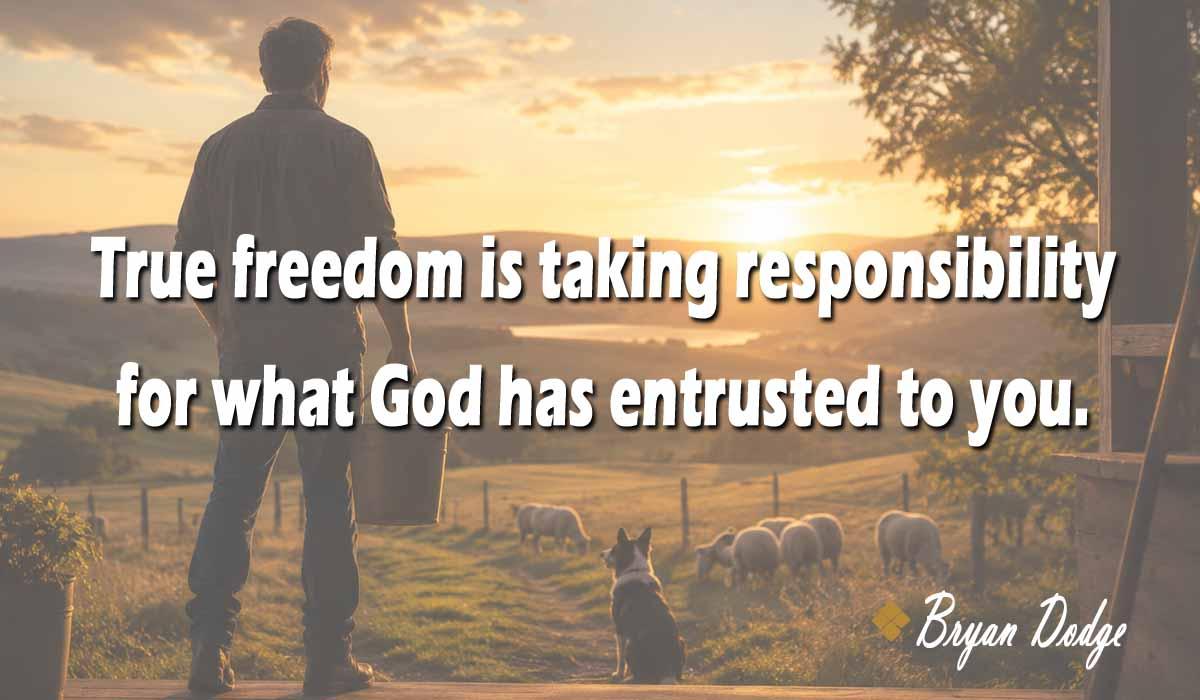
” True freedom is taking responsibility for what God has entrusted to you.” – Bryan Dodge
Every July, America pauses to remember something precious: freedom. We watch fireworks, wave flags, and think about the men and women who sacrificed everything so others could live free. But freedom has never been free. It has always come with a price. And if we look closely at that truth, we find a lesson that reaches far beyond national history and straight into our own lives, our own homes, and our own businesses.
Leadership works the same way. The greatest battle any business owner faces isn’t against a competitor down the street or the ups and downs of the economy. It’s the battle within. Before a person can lead a company, a family, or a team, they must first learn to lead themselves. That is where real freedom begins not in doing whatever we want, but in taking ownership of what we’ve been given.
Freedom Without Responsibility Becomes Chaos
Here is a truth every leader eventually discovers: an organization becomes a reflection of the person leading it. When no one steps up to take responsibility, things start to unravel. Problems that could have been solved early are left to grow. Accountability quietly disappears. Trust erodes a little more each day. Mediocrity becomes the accepted standard instead of the exception. People start pointing fingers instead of rolling up their sleeves.
This isn’t unique to business. It happens in families, in churches, in communities, and yes, in nations too. Freedom without responsibility always drifts toward disorder. But ownership does the opposite. Ownership creates order. When someone is willing to say “this is on me,” things begin to stabilize. Decisions get made. Problems get solved. People start to trust again.
Stewardship, Not Just Ownership
There’s a deeper principle at work here, one rooted in something bigger than business strategy. Everything we have ultimately belongs to God. We don’t create it out of nothing and we don’t keep it forever. We are simply entrusted to manage it well for a season.
Think about everything that’s been placed in your hands: your faith, your marriage, your children, the people who work for you, the customers who trust you, the money that flows through your accounts, the reputation you’ve built, the influence you carry, the hours in your day, and the opportunities that come your way. None of it is truly ours in the deepest sense. We are stewards, not owners in the ultimate sense of the word. Scripture puts it plainly: to whom much is given, much will be required. That’s not meant to feel like a burden hanging over our heads. It’s meant to remind us that what we’ve been given matters, and how we handle it matters even more. The person who understands this doesn’t walk around anxious about losing control. They walk around grateful for the chance to manage something meaningful.
Ownership Creates Influence
Here’s something worth sitting with for a moment. A title can hand someone authority. But influence is different. Influence is earned, and it’s earned through ownership.
People don’t naturally follow someone just because of the letters after their name or the corner office they sit in. They follow people who accept responsibility when things go wrong instead of looking for someone to blame. They follow people who are willing to admit mistakes instead of hiding them. They follow people who solve problems instead of just pointing them out. They follow people who protect others before protecting themselves, who set the standard through their own actions, and who stay accountable even when no one is watching.
Real leadership was never about being in charge. It’s about being the first one willing to take responsibility when responsibility is hard to take.
The Difference Between Employees and Owners
There’s a mindset shift that separates people who merely have a job from people who actually lead, and it doesn’t depend on their job title at all.
Someone with an employee mindset waits to be told what to do. Someone with an owner’s mindset looks around and asks what needs to be done. One notices problems and mentions them in passing. The other sees a problem and starts working on a solution before anyone even asks. One protects their own position, careful not to step outside their lane. The other protects the mission, willing to do whatever it takes to see it succeed.
This isn’t about job descriptions. It’s about posture. The best leaders don’t just carry this mindset themselves they build a culture where everyone around them starts to think and act like an owner too. That kind of culture doesn’t happen by accident. It happens because someone modeled it first.
Ownership Takes Courage
Let’s be honest about something. Ownership is not comfortable. It never has been.
Taking real ownership means having the difficult conversation you’ve been avoiding. It means making a decision that won’t be popular, even when you know it’s the right one. It means holding someone accountable instead of letting things slide because confrontation feels awkward. It means saying no when saying yes would be easier. It means being the one to ask for forgiveness instead of waiting for someone else to apologize first. It means admitting a mistake out loud instead of quietly hoping no one noticed. It means being willing to change direction, even after you’ve already invested time and energy into the old plan.
None of that is easy. But none of it is optional either, if you want to lead well. Ownership isn’t for the comfortable. It’s for the courageous.
Ownership Spreads
Here’s something every leader should pay close attention to: culture always flows downhill from leadership. Whatever the person at the top demonstrates, the rest of the team eventually absorbs.
If the leader blames others when things go wrong, don’t be surprised when the whole team starts doing the same thing. If the leader serves quietly and consistently, that spirit of service starts showing up everywhere, often in places the leader never even sees. If the leader keeps growing and learning, that hunger for growth spreads through the team almost without anyone noticing.
People don’t simply listen to what their leaders say. They watch what their leaders do, and then they imitate it. That’s a sobering thought, but it’s also an encouraging one. It means the way you choose to lead today is already shaping the people around you tomorrow.
One Day, We Will Give an Account
It’s worth stepping back from the day-to-day grind for a moment and thinking about the bigger picture. One day, none of us will stand before God and be asked how much money we made, how many locations we opened, or how well-known our name became. Those questions won’t matter in that moment.
Instead, the question will be simple and direct: were you faithful with what I entrusted to you? That is the true measure of a life well lived, and it puts everything else in proper perspective. Success isn’t ultimately measured by the size of what we built. It’s measured by the faithfulness with which we managed it.
Questions Worth Asking Yourself
Take a moment and be honest with yourself. What responsibility have you been avoiding lately? What conversation have you kept putting off because it feels uncomfortable? Where have you blamed someone else instead of stepping up to lead? Who in your life could use a word of encouragement from you today? What part of your business, your home, or your own habits reflects a lack of ownership on your part? And maybe the hardest question of all: if everyone on your team led exactly the way you lead, what kind of organization would you end up with?
These aren’t questions to answer quickly and move on from. Sit with them. Let them do their work.
A Challenge Worth Accepting
This month, choose to take ownership of one relationship that needs your attention. Take ownership of one difficult decision you’ve been putting off. Take ownership of one opportunity you’ve let sit neglected for too long. Take ownership of your own growth instead of waiting for someone else to push you toward it.
Don’t wait for someone else to lead first. Become the leader you were created to be.
Freedom is one of God’s greatest gifts, but it was never meant to free us from responsibility. It was given to free us for responsibility. God has entrusted each of us with people to influence, resources to steward, opportunities to seize, and a legacy to leave behind. The question isn’t whether you’ve been given much. The question is whether you’ll faithfully steward what has already been placed in your hands.
Because the greatest freedom isn’t found in doing whatever you want. It’s found in becoming the person God created you to be by taking ownership of everything He has entrusted to your care. And that ownership starts in a simple, often overlooked place: we are all called to be leaders of our own lives first. Before we can lead a business, a team, or a family well, we must take ownership of our own character, our own choices, and our own relationship with God. That’s where freedom of ownership truly begins.
Comments are closed